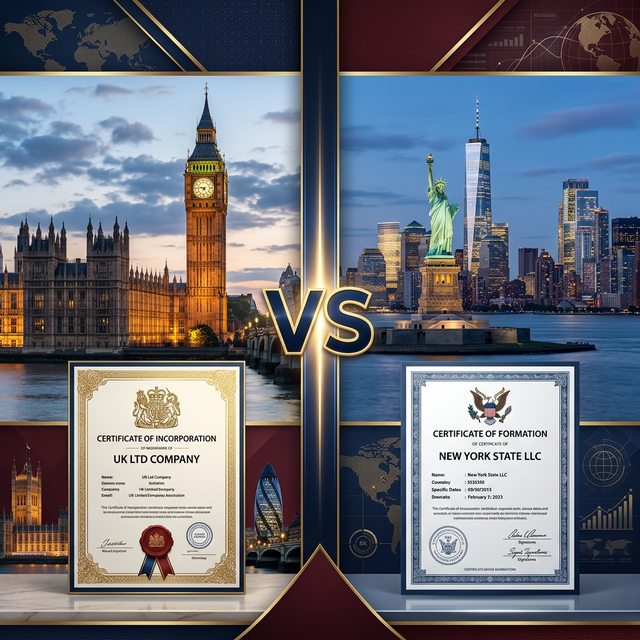
The Battle of the Business Jurisdictions
If you are a tech founder looking to raise venture capital or a global business scaling across borders, you will inevitably face a choice between two of the most popular legal jurisdictions on Earth: the United Kingdom and the State of Delaware, USA.
Both are legendary for their legal stability, investor-friendly laws, and corporate prestige. But which is the right foundation for your specific venture in 2026? This guide dissects the "Transatlantic Legal Divide."
1. Investor Perception and Fundraising
The Delaware C-Corp Standard
For Silicon Valley VCs, the Delaware C-Corp is the non-negotiable standard. Why? Because Delaware’s Court of Chancery is a specialized court for corporate disputes, providing a level of legal predictability that is unmatched in the US.
- Best For: Founders seeking US-based venture capital or a NASDAQ/NYSE listing.
The UK Ltd Alternative
The UK Private Limited Company is the "Delaware of Europe." It is the standard for European and Asian investors. UK law is well-understood globally and provides strong protections for minority shareholders—often more so than Delaware law.
- Best For: Founders looking at a global or European exit, or those seeking a structured, transparent legal environment.
2. Taxation and Structure
Delaware C-Corp: Double Taxation
A C-Corp is a separate tax entity. It pays federal corporate tax (21%), and dividends are taxed again at the shareholder level. While there are incentives like Section 1202 (Qualified Small Business Stock) which can eliminate capital gains tax on some exits, the day-to-day tax burden is significant.
UK Ltd: The Global Compact
The UK has one of the lowest corporation tax rates in the G7 (19-25%). Furthermore, the UK has an extensive network of tax treaties, making it an excellent hub for holding intellectual property or managing global subsidiaries.
3. Maintenance Costs and Compliance
Delaware C-Corp
- Annual Fees: State franchise tax can range from $175 to over $200,000 depending on the number of shares.
- Compliance: Requires a registered agent and strict adherence to corporate formalities (bylaws, board meetings, minutes).
UK Ltd
- Annual Fees: Minimal (£34 confirmation statement).
- Compliance: Requires annual accounts filing. While strict, the transparency of the UK register is seen as a badge of honor and trustworthiness.
4. Operational Flexibility
Delaware C-Corp
Extremely flexible. You can issue different classes of stock and create complex vesting schedules with ease. However, opening a bank account as a non-resident director is becoming increasingly difficult in 2026.
UK Ltd
Equally flexible but more supervised. The UK’s Companies House ensures that the basic structure of the company is always clear and public. Banking is highly accessible through the UK’s advanced fintech ecosystem.
5. Comparison Summary Table
| Feature | Delaware C-Corp | UK Private Ltd |
|---|---|---|
| Primary Market | USA / Silicon Valley | Global / UK / Europe |
| Legal System | Delaware Court of Chancery | English Common Law |
| Capital Gains | Potential 0% (Section 1202) | Business Asset Disposal Relief |
| Maintenance | Moderate to High | Low |
| Suitability | VC-backed startups | Tech, E-commerce, Services |
Conclusion: Which should you choose?
If your goal is to be the next "Unicorn" funded by Sequoia or a16z, the Delaware C-Corp is likely your path. However, if you are building an international business, valuing low maintenance costs and high global prestige, the UK Ltd offers a foundation that is just as strong and far more accessible for global founders.
Build your legal foundation in the UK. View our Company Formation packages.
Deep Dive
More in Business Strategy
Foundational Insight
The 2026 regulatory shift demands proactive compliance. Don't let your formation be stalled by identity verification gaps.
Secure Compliance Now
Sarah from London
Just registered a company • 2m ago