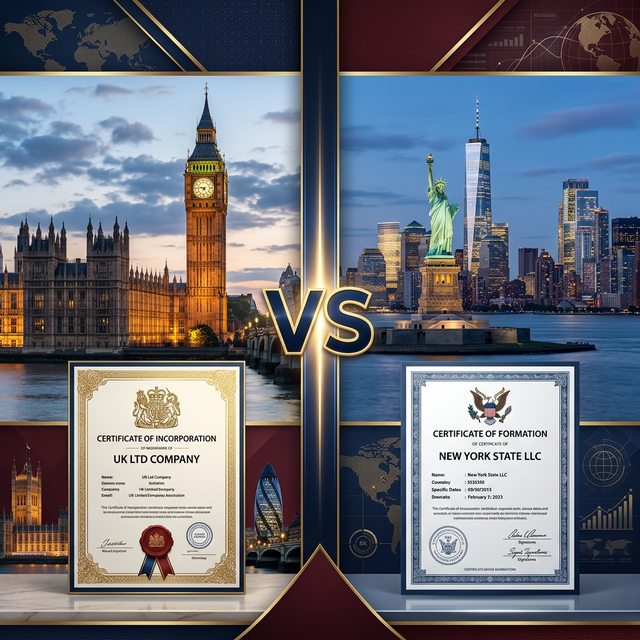
The Big Choice for Bosses
Are you a founder far from home trying to pick between a UK Ltd and a US LLC? This is a big choice. It is a key step for your business. Two main spots rule the world: the United Kingdom (UK) and the United States (US).
In 2026, global tax rules changed. Remote life grew fast. The "best" choice is not the same for everyone. It depends on your buyers, your tax home, and your long term plan. This deep guide gives a close look at both setups. We compare tax, banks, rules, trust, and yearly costs so you can choose well today.
Quick hint: if you want strong EU banking, high trust, and a true global base, the UK Ltd often wins. If your firm is mostly in the US and you want a pass-through tax, the US LLC is nice. Ready to pick? Read our UK firm guide for remote founders or our USA to UK guide.
Quick Links
- Interactive Decision Tool
- Cost Calculator
- Watch the Video
- Taxes and Profits
- Rules and Upkeep
- Banks and Payments
- Trust and Investors
- Investor Readiness Deep Dive
- Case Study: Sarah's Shift
- Summary Table
- LLC Equivalent in UK
- Which One to Choose
Interactive Structure Decision Matrix
Not sure which structure fits your goals? Answer these quick questions and get a tailored recommendation based on your specific situation:
Structure Decision Matrix
Answer all five questions to receive a personalised structure recommendation.
<div class="space-y-5">
    <div>
        <label class="block text-xs font-black text-gray-700 uppercase tracking-wider mb-2">Where are most of your buyers?</label>
        <div class="flex flex-wrap gap-2">
            <button @click="market = 'eu'" :class="market === 'eu' ? 'bg-blue-600 text-white border-blue-600' : 'bg-white text-gray-700 border-gray-200'" class="px-4 py-2 rounded-xl text-xs font-bold border transition-all hover:shadow-md">EU / UK</button>
            <button @click="market = 'us'" :class="market === 'us' ? 'bg-blue-600 text-white border-blue-600' : 'bg-white text-gray-700 border-gray-200'" class="px-4 py-2 rounded-xl text-xs font-bold border transition-all hover:shadow-md">USA Only</button>
            <button @click="market = 'global'" :class="market === 'global' ? 'bg-blue-600 text-white border-blue-600' : 'bg-white text-gray-700 border-gray-200'" class="px-4 py-2 rounded-xl text-xs font-bold border transition-all hover:shadow-md">Global / Mixed</button>
        </div>
    </div>

    <div>
        <label class="block text-xs font-black text-gray-700 uppercase tracking-wider mb-2">What is your tax home?</label>
        <div class="flex flex-wrap gap-2">
            <button @click="taxHome = 'us'" :class="taxHome === 'us' ? 'bg-blue-600 text-white border-blue-600' : 'bg-white text-gray-700 border-gray-200'" class="px-4 py-2 rounded-xl text-xs font-bold border transition-all hover:shadow-md">US Citizen / Resident</button>
            <button @click="taxHome = 'non-us'" :class="taxHome === 'non-us' ? 'bg-blue-600 text-white border-blue-600' : 'bg-white text-gray-700 border-gray-200'" class="px-4 py-2 rounded-xl text-xs font-bold border transition-all hover:shadow-md">Non-US (Global)</button>
        </div>
    </div>

    <div>
        <label class="block text-xs font-black text-gray-700 uppercase tracking-wider mb-2">Expected annual revenue?</label>
        <div class="flex flex-wrap gap-2">
            <button @click="revenue = 'low'" :class="revenue === 'low' ? 'bg-blue-600 text-white border-blue-600' : 'bg-white text-gray-700 border-gray-200'" class="px-4 py-2 rounded-xl text-xs font-bold border transition-all hover:shadow-md">Under $50k</button>
            <button @click="revenue = 'high'" :class="revenue === 'high' ? 'bg-blue-600 text-white border-blue-600' : 'bg-white text-gray-700 border-gray-200'" class="px-4 py-2 rounded-xl text-xs font-bold border transition-all hover:shadow-md">Over $50k</button>
        </div>
    </div>

    <div>
        <label class="block text-xs font-black text-gray-700 uppercase tracking-wider mb-2">Primary banking need?</label>
        <div class="flex flex-wrap gap-2">
            <button @click="banking = 'multi'" :class="banking === 'multi' ? 'bg-blue-600 text-white border-blue-600' : 'bg-white text-gray-700 border-gray-200'" class="px-4 py-2 rounded-xl text-xs font-bold border transition-all hover:shadow-md">Multi-Currency (GBP / EUR / USD)</button>
            <button @click="banking = 'usd'" :class="banking === 'usd' ? 'bg-blue-600 text-white border-blue-600' : 'bg-white text-gray-700 border-gray-200'" class="px-4 py-2 rounded-xl text-xs font-bold border transition-all hover:shadow-md">USD Only</button>
        </div>
    </div>

    <div>
        <label class="block text-xs font-black text-gray-700 uppercase tracking-wider mb-2">Investment plan?</label>
        <div class="flex flex-wrap gap-2">
            <button @click="investors = 'vc'" :class="investors === 'vc' ? 'bg-blue-600 text-white border-blue-600' : 'bg-white text-gray-700 border-gray-200'" class="px-4 py-2 rounded-xl text-xs font-bold border transition-all hover:shadow-md">Seeking VC / Angel Funds</button>
            <button @click="investors = 'bootstrap'" :class="investors === 'bootstrap' ? 'bg-blue-600 text-white border-blue-600' : 'bg-white text-gray-700 border-gray-200'" class="px-4 py-2 rounded-xl text-xs font-bold border transition-all hover:shadow-md">Self-Funded / Bootstrapped</button>
        </div>
    </div>
</div>

<div x-show="allAnswered" x-transition class="mt-6 p-6 rounded-2xl border" :class="recommendation === 'uk' ? 'bg-blue-50 border-blue-200' : recommendation === 'us' ? 'bg-green-50 border-green-200' : 'bg-amber-50 border-amber-200'">
    <div class="flex items-center gap-3 mb-3">
        <span class="text-2xl" x-text="recommendation === 'uk' ? '🇬🇧' : recommendation === 'us' ? '🇺🇸' : '🌍'"></span>
        <span class="text-sm font-black text-gray-900" x-text="recommendation === 'uk' ? 'UK Ltd is your best match' : recommendation === 'us' ? 'US LLC is your best match' : 'Consider running both structures'"></span>
    </div>
    <p class="text-xs text-gray-600 leading-relaxed" x-text="recommendation === 'uk' ? 'Based on your answers, a UK Limited Company offers the best mix of banking access, trust, and compliance simplicity for your situation. The UK fintech ecosystem and EU market alignment will serve your business goals well.' : recommendation === 'us' ? 'Based on your answers, a US LLC offers strong advantages through pass-through taxation, USD banking simplicity, and direct access to the American market. Consider a state like Wyoming or Delaware for favourable LLC laws.' : 'Your business profile suggests benefits from both structures. Many global founders operate a UK Ltd for EU/international trade alongside a US LLC for American sales. The two entities can transact with each other legally.'"></p>
    <a href="/pricing" class="mt-4 inline-block px-6 py-3 bg-blue-600 text-white rounded-xl text-xs font-black uppercase tracking-wider hover:bg-blue-700 transition shadow-lg">Start Your Formation →</a>
</div>

<p class="text-[10px] text-gray-400 mt-4 leading-relaxed">Note: This tool provides general guidance only. Your optimal structure depends on personal tax residency, treaty networks, and business-specific factors. Consult a qualified accountant before making a final decision.</p>
Video: UK Ltd vs US LLC
Watch our quick video to learn which firm type is right for you:
1. Taxes: The Main Difference
UK Ltd: The Firm Tax Way
A UK Ltd is taxed on its own. It pays a Firm Tax on its cash gains (about 19% to 25% in 2026). If you take cash out as pay or a share, you are taxed on that too.
- Good: Low tax on cash kept in the firm to grow it.
- Bad: Double tax is possible if you do not plan well.
The 2026 UK budget confirmed the small profits rate of 19% for companies earning under £50,000 in taxable profit. The main rate of 25% applies to profits over £250,000. Between those two limits, a tapered marginal relief applies. This means most small and medium UK Ltd companies benefit from the lower end of the scale, making the effective tax rate one of the lowest in the G7 group of nations.
US LLC: The "Pass-Through" Edge
For non-US folks, the US LLC is often clear. This means the LLC itself pays no federal income tax. The gains "pass through" to the owners. The owners pay tax in their home country.
- Good: Chance for 0% US tax if you have no US-based gains.
- Bad: Hard IRS forms to fill out (Form 1120/5472). Strict rules apply.
A critical point many founders miss: the 0% US tax on an LLC only works if you have zero effectively connected income (ECI) to the United States. If you hire US contractors, use US servers extensively, or attend US trade shows to generate sales, the IRS may argue your income is effectively connected to the US. This can trigger a full federal tax obligation plus harsh penalties. The Form 5472 reporting requirement alone carries a $25,000 penalty per form if filed late or incorrectly.
Side-by-Side Tax Breakdown
| Tax Factor | UK Ltd | US LLC (Non-US Owner) |
|---|---|---|
| Base Tax Rate | 19% (small) to 25% (main) | 0% federal (if no ECI) |
| Self-Assessment | Not required for the entity | Owners report in home country |
| Penalty for Late Filing | £150 to £1,500 | $25,000+ per form |
| VAT Registration | Required above £90k turnover | No US equivalent (varies by state) |
| Dividend Tax | 8.75% to 39.35% (if UK resident) | Depends on home country |
2. Ease of Upkeep and Rules
UK Ltd: Clear and Open
UK rules are tough but clear. You must file a Status Check and Yearly Accounts. The UK public record (Companies House) is open. This openness brings huge trust from the whole world.
- Upkeep Cost: Medium.
Under the 2026 Economic Crime and Corporate Transparency Act, all new company formations now require ACSP (Authorised Corporate Service Provider) identity verification. This means every director and person with significant control must be biometrically verified before the company can be registered. While this adds a step, it has significantly increased the credibility of UK-registered companies in the eyes of international banks and payment processors.
US LLC: Changes by State
A US LLC in Wyoming or Delaware has few state rules. You just file a simple yearly report. But federal IRS forms for foreign owners are very strict. They give huge fines if you are late.
- Upkeep Cost: Low (State) to High (Tax Help).
The compliance landscape for foreign-owned US LLCs shifted dramatically in 2024 with the Corporate Transparency Act (CTA), which requires Beneficial Ownership Information (BOI) reports to be filed with FinCEN. Non-compliant companies face daily penalties. Combined with Form 5472 obligations, the total annual compliance cost for a foreign-owned US LLC now ranges from $1,500 to $3,000 when professional tax help is factored in, sometimes exceeding a UK Ltd's total compliance cost.
3. Banks and Payment Gateways
UK Ltd: The EU Power House
A UK firm is top-tier for EU payment tools like Stripe and PayPal. The UK fintech scene (Wise, Revolut, Tide) leads the globe. This lets you get multi-cash accounts that are easy to run from afar.
The approval rates tell the story. In 2026, Wise Business approves roughly 95% of UK Ltd applications from non-resident directors. Revolut Business and Tide maintain similar acceptance rates. This means that a founder in Pakistan, India, the UAE, or Nigeria can form a UK Ltd and have a functioning business bank account with a local GBP sort code within 48 hours, all without stepping foot in the United Kingdom. For a deeper look at how to set this up, read our UK business banking guide for non-residents.
US LLC: The Dollar King
If your main buyers are in the US, a US LLC helps. It makes getting a US bank (like Mercury or Relay) and a US Stripe account very smooth. But, being a foreign owner makes the process much harder in 2026 due to tight KYC rules.
Mercury has tightened its onboarding for foreign-owned US LLCs significantly. Many founders from South Asia and Africa report rejection rates above 40%. By contrast, Mercury accepts UK Ltd companies with far less friction when the company already has verified directors through the ACSP process. This creates a paradox: forming a UK Ltd first can actually make it easier to get a US bank account than forming a US LLC directly.
4. Trust and How Investors See You
UK Ltd: Big Firm Trust
British law is the base of global trade. Backers in the EU and Asia often prefer a UK Ltd. They like the strong legal shield and the open public record of who runs the firm.
US LLC: Quick Startup Speed
The US LLC is fast. It is great for solo founders. But, if you want to raise big venture cash, you will likely need to change to a Delaware C-Corp. This adds hard steps that the UK Ltd avoids. A UK Ltd stays an Ltd as it grows.
5. Investor Readiness: Seed to Series A
A factor many founders overlook is how each structure handles growth from bootstrap to funded startup. The path is very different for each:
UK Ltd: Smooth Scaling Path
A UK Private Limited Company is already structured to issue shares, create different share classes (ordinary, preference, non-voting), and accept external investment. When a UK angel investor or VC fund wants to invest, the process is straightforward: issue new shares, file an SH01 return of allotment with Companies House, and update the PSC register. The same legal entity scales from a one-person startup to a 50-person company without structural changes.
Key advantages for fundraising:
- EIS and SEIS Tax Relief: UK investors can claim 30% to 50% tax relief on investments into qualifying UK Ltd companies. This makes your company significantly more attractive to UK and EU angel investors.
- Convertible Loan Notes: Standard UK convertible instruments are well-understood by European investors and accelerators.
- No Conversion Needed: Unlike a US LLC, you never need to "convert" your entity type to accept investment.
US LLC: The Conversion Bottleneck
Most serious US investors (Y Combinator, Techstars, angel syndicates) refuse to invest in LLCs. They require a Delaware C-Corporation. This means if you start with an LLC and later seek funding, you must:
- Form a new Delaware C-Corp
- Transfer all assets, contracts, and IP from the LLC to the new C-Corp
- Dissolve the original LLC
- Re-negotiate all bank accounts and payment processor agreements
This process typically costs $5,000 to $15,000 in legal fees and causes 4 to 8 weeks of operational disruption. Many founders lose existing Stripe or PayPal integrations during the migration, forcing them to re-apply under the new entity.
Interactive Annual Cost Comparison Calculator
Use this tool to compare the true yearly cost of running a UK Ltd vs a US LLC based on your situation:
Annual Cost Comparison Calculator
Compare the real yearly running costs of a UK Ltd vs a US LLC. Adjust the options to match your setup.
<div class="space-y-5 mb-6">
    <div>
        <label class="block text-xs font-black text-gray-700 uppercase tracking-wider mb-2">US LLC State</label>
        <div class="flex flex-wrap gap-2">
            <button @click="state = 'wyoming'" :class="state === 'wyoming' ? 'bg-blue-600 text-white border-blue-600' : 'bg-white text-gray-700 border-gray-200'" class="px-4 py-2 rounded-xl text-xs font-bold border transition-all hover:shadow-md">Wyoming</button>
            <button @click="state = 'delaware'" :class="state === 'delaware' ? 'bg-blue-600 text-white border-blue-600' : 'bg-white text-gray-700 border-gray-200'" class="px-4 py-2 rounded-xl text-xs font-bold border transition-all hover:shadow-md">Delaware</button>
            <button @click="state = 'other'" :class="state === 'other' ? 'bg-blue-600 text-white border-blue-600' : 'bg-white text-gray-700 border-gray-200'" class="px-4 py-2 rounded-xl text-xs font-bold border transition-all hover:shadow-md">Other State</button>
        </div>
    </div>

    <div>
        <label class="block text-xs font-black text-gray-700 uppercase tracking-wider mb-2">Do you hire a professional accountant?</label>
        <div class="flex flex-wrap gap-2">
            <button @click="needsAccountant = true" :class="needsAccountant ? 'bg-blue-600 text-white border-blue-600' : 'bg-white text-gray-700 border-gray-200'" class="px-4 py-2 rounded-xl text-xs font-bold border transition-all hover:shadow-md">Yes — Professional Help</button>
            <button @click="needsAccountant = false" :class="!needsAccountant ? 'bg-blue-600 text-white border-blue-600' : 'bg-white text-gray-700 border-gray-200'" class="px-4 py-2 rounded-xl text-xs font-bold border transition-all hover:shadow-md">No — I Do It Myself</button>
        </div>
    </div>
</div>

<div class="grid grid-cols-1 md:grid-cols-2 gap-4">
    <div class="bg-white p-5 rounded-2xl border border-blue-100 text-left">
        <div class="flex items-center gap-2 mb-4">
            <span class="text-lg">🇬🇧</span>
            <span class="text-xs font-black text-gray-900 uppercase tracking-wider">UK Ltd Annual Costs</span>
        </div>
        <div class="space-y-2 text-xs">
            <div class="flex justify-between"><span class="text-gray-500">Confirmation Statement</span><span class="font-bold text-gray-900" x-text="'£' + ukCosts.gov"></span></div>
            <div class="flex justify-between"><span class="text-gray-500">London Virtual Address</span><span class="font-bold text-gray-900" x-text="'£' + ukCosts.address"></span></div>
            <div class="flex justify-between"><span class="text-gray-500">ACSP Verification</span><span class="font-bold text-gray-900" x-text="'£' + ukCosts.acsp"></span></div>
            <div class="flex justify-between" x-show="needsAccountant"><span class="text-gray-500">Accountant (Annual Accounts)</span><span class="font-bold text-gray-900" x-text="'£' + ukCosts.accounts"></span></div>
            <div class="flex justify-between border-t border-gray-100 pt-2 mt-2"><span class="font-black text-gray-900">Total</span><span class="font-black text-blue-600" x-text="'£' + ukCosts.total"></span></div>
        </div>
    </div>

    <div class="bg-white p-5 rounded-2xl border border-green-100 text-left">
        <div class="flex items-center gap-2 mb-4">
            <span class="text-lg">🇺🇸</span>
            <span class="text-xs font-black text-gray-900 uppercase tracking-wider">US LLC Annual Costs</span>
        </div>
        <div class="space-y-2 text-xs">
            <div class="flex justify-between"><span class="text-gray-500">State Annual Fee</span><span class="font-bold text-gray-900" x-text="'$' + usCosts.stateFee"></span></div>
            <div class="flex justify-between"><span class="text-gray-500">Registered Agent</span><span class="font-bold text-gray-900" x-text="'$' + usCosts.agent"></span></div>
            <div class="flex justify-between" x-show="needsAccountant"><span class="text-gray-500">IRS Tax Filing (5472 + 1120)</span><span class="font-bold text-gray-900" x-text="'$' + usCosts.taxFiling"></span></div>
            <div class="flex justify-between border-t border-gray-100 pt-2 mt-2"><span class="font-black text-gray-900">Total</span><span class="font-black text-green-600" x-text="'$' + usCosts.total"></span></div>
        </div>
    </div>
</div>

<div class="mt-4 p-4 rounded-xl text-center" :class="savings > 0 ? 'bg-blue-50 border border-blue-100' : 'bg-green-50 border border-green-100'">
    <span class="text-xs font-black" :class="savings > 0 ? 'text-blue-700' : 'text-green-700'" x-text="savings > 0 ? 'The UK Ltd saves you roughly $' + savings + '/year in running costs' : 'The US LLC saves you roughly $' + Math.abs(savings) + '/year in running costs'"></span>
</div>

<p class="text-[10px] text-gray-400 mt-3 leading-relaxed">Note: Costs shown are typical estimates for 2026. UK costs shown in GBP; US costs in USD. Actual fees may vary by provider. Currency conversion not applied for simplicity.</p>
Case Study: Why Sarah Chose a UK Ltd
Meet Sarah. Sarah lives in the UAE. She runs an online shop. At first, she opened a Wyoming LLC. It was cheap. But soon she had a big problem. Stripe blocked her LLC. European banks said no to her forms.
She swapped to a UK Ltd. With our help, she got a London address. She opened a Wise Business account in one day. Stripe UK approved her firm very fast. Her EU buyers felt safe buying from a British firm.
Sarah saw her sales grow. The open public rules of the UK Ltd gave her the trust she needed to scale.
The Numbers Behind Sarah's Switch
Within three months of switching from her US LLC to a UK Ltd, Sarah saw measurable improvements across her business:
- Payment Acceptance Rate: Rose from 72% to 96% after switching to Stripe UK.
- Currency Conversion Costs: Dropped from 3.2% (US merchant via PayPal) to 0.5% (Wise mid-market rate).
- Customer Trust Score: EU customers reported higher confidence purchasing from a UK-registered entity in post-sale surveys.
- Monthly Banking Fees: Dropped from $45/month (US Mercury) to £0/month (Wise Business, no monthly fee).
The lesson is clear: the cheapest entity to form is not always the cheapest entity to run.
6. Summary Table: UK Ltd vs US LLC
| Fact | UK Private Ltd | US LLC (Foreign Owner) |
|---|---|---|
| Legal Type | Its own entity | Pass-through entity |
| Federal Tax | Firm Tax (19-25%) | 0% (if no US gains) |
| Public Info | High (Open Record) | Low (Secret in some states) |
| Banks | Great (Fintech-friendly) | Great (US-focused) |
| Best For | Global trade, EU focus | Solo web firm, US sales |
| Investor Path | Direct share issue (EIS/SEIS) | Must convert to C-Corp |
| Compliance Cost | £158 to £508/year | $185 to $2,125/year |
| Stripe Approval | ~95% acceptance | ~60% for foreign owners |
| Identity Verification | ACSP biometric check | BOI report + state filings |
What Is the UK Match for an LLC?
If you search for "LLC United Kingdom", the answer is: a UK Private Limited Company (Ltd). The UK has no exact match for the US LLC. A UK Ltd works in a similar way. It shields the owners from firm debts.
Key differences from a US LLC:
- Its own entity: A UK Ltd is its own legal "person". It is never a "disregarded entity" like a single-member US LLC.
- No pass-through tax: UK Ltd gains face Firm Tax. You cannot choose to be taxed as a solo trader.
- Open record: All UK Ltd details and bosses are public on the UK state website. US LLCs in states like Wyoming keep more secrets.
For remote folks who want a shield from debts but with strong EU banks and high trust, the UK Ltd is the top choice. Do you want to check costs first? Use our UK firm cost breakdown. If banks are your focus, read our UK business banking guide. If you want to compare a UK firm and a US startup firm, read our UK firm vs Delaware C-Corp post.
Questions and Answers: UK Ltd vs US LLC
Is a UK Ltd the same as an LLC?
No. Both shield you from debt, but they differ in tax, rules, and law type. A UK Ltd is its own tax entity. A US LLC can be a pass-through entity.
Can a US citizen own a UK Ltd?
Yes. A US citizen can be the sole boss and 100% owner of a UK Limited Company. You do not need to live in the UK. See our US citizens guide for details.
Which is cheaper to keep up — UK Ltd or US LLC?
It depends. A Wyoming LLC has lower state costs (~$50/yr). But foreign owners face high IRS forms costs. A UK Ltd costs about £13/yr for the State Check, plus fees to file Yearly Accounts. Use our cost calculator above to compare based on your specific situation.
Which is better for EU clients?
The UK Ltd is much better. EU suppliers, payment tools (Stripe, PayPal), and banks trust a UK Limited Company far more than a foreign US LLC.
Can I have both a UK Ltd and a US LLC?
Yes. Many smart bosses keep both. They use a US LLC for US deals and a UK Ltd for EU growth. The two firms can make deals with each other.
Which is better for forex prop trading?
For non-US folks, the UK Ltd is the best. It gives you an easy banking setup (Wise, Revolut) and works well with FCA-regulated platforms. See our forex trading review for more details.
Can I change my LLC to a UK Ltd?
Not directly. You must close the LLC and open a new UK Ltd. You can not just flip a switch to swap them.
Which gives more privacy?
The US LLC in Wyoming gives more privacy. A UK Ltd puts your name on an open public website.
Does a UK Ltd protect my personal house?
Yes. A UK Ltd limits your risk. If the firm fails, your personal house and cash are safe.
Do I need to visit the UK or US?
No. You can open and run both a UK Ltd and a US LLC from your home laptop.
What about the new 2026 UK identity rules?
All new UK Ltd formations now require ACSP biometric identity verification. This adds a layer of trust and compliance that makes UK companies more credible in the eyes of international banks. Read more in our UK formation guide.
Can I open Stripe with a UK Ltd from abroad?
Yes. Stripe UK has a roughly 95% approval rate for UK Ltd companies, even when the director lives outside the UK. You link your Wise or Revolut business account as the payout destination.
Ready to Pick Your Setup?
If you value openness, high trust, and EU bank access, the UK Ltd is the clear winner. If you are a solo boss with no physical footprint in the US and want to pay zero tax through a pass-through entity, the US LLC might suit you well.
At UK Ltd Registration, we focus on helping global founders build their UK base fast and right. To make your choice easy, this page links straight to the three main steps most folks take next: formation, pricing, and banks.
Start UK Ltd setup now → Compare setup plans → Check business bank choices → Read the full remote setup guide →
Recommended Business Banking for Your UK LTD
Setting up the right business bank account is one of the most important steps after forming your UK LTD. Here are our recommended providers:
Wise Business
- Best for: Non-resident founders receiving and converting multiple currencies
- Key benefit: Hold 40+ currencies, get local account details (GBP, USD, EUR), low conversion fees
- Open a Wise Business Account →
Revolut Business
- Best for: Startups needing multi-currency accounts with integrated expense management
- Key benefit: 25+ currencies, virtual IBAN, corporate card, accounting integrations
- Open a Revolut Business Account →
Mercury
- Best for: US/UK tech startups with dual currency needs
- Key benefit: USD + GBP accounts, startup-focused banking, no monthly fees
- Open a Mercury Account →
Disclosure: UK LTD Registration may receive a commission if you sign up through our links. This helps us keep our guides free and up to date — at no extra cost to you.
Deep Dive
More in Business Strategy
Foundational Insight
The 2026 regulatory shift demands proactive compliance. Don't let your formation be stalled by identity verification gaps.
Secure Compliance Now
Sarah from London
Just registered a company • 2m ago