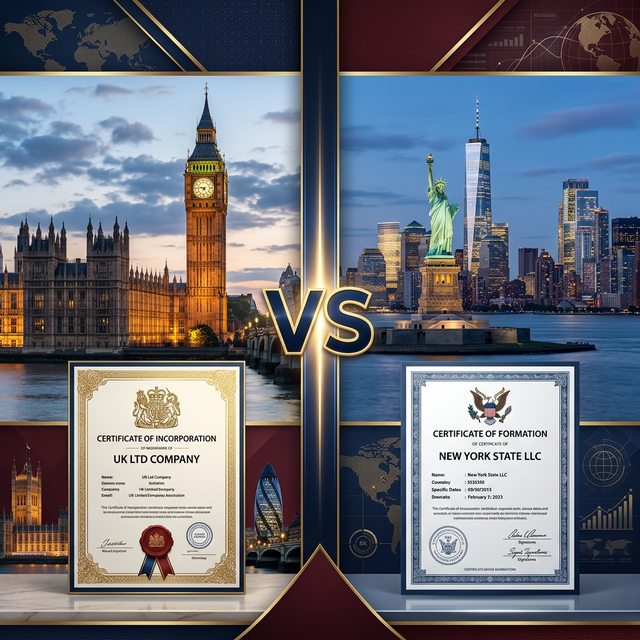
When international entrepreneurs look to register a new business, the debate often comes down to: UK Limited Company, or a traditional Offshore Company (like BVI, Belize, Seychelles).
In 2026, the landscape of international business has drastically changed. What used to be a tax loophole is now a banking nightmare. This guide breaks down why the UK Ltd is becoming the preferred choice over offshore tax havens for serious businesses.
The Death of the Traditional "Tax Haven"
For decades, registering an offshore company was seen as the ultimate tax strategy. However, due to the Common Reporting Standard (CRS) and increased global regulatory pressure, traditional tax havens are facing unprecedented scrutiny.
Why Offshore is Losing Its Appeal:
- Banking Blacklists: Most top-tier banks will outright reject accounts from BVI, Seychelles, and Belize companies.
- Reputation Issues: Clients and partners are increasingly suspicious of businesses operating from tax havens.
- Payment Gateways: Stripe, PayPal, and Square heavily restrict or completely ban accounts from traditional offshore jurisdictions.
- Substance Requirements: Many jurisdictions now require "economic substance" (real local offices and employees), destroying the cost-saving aspect.
Why the UK Limited Company is the "New Offshore"
A UK Limited Company offers significant advantages over traditional offshore structures, even for non-residents.
1. 100% Global Credibility
A UK company is instantly recognized and trusted globally. Whether you are dealing with European suppliers or American clients, a UK Ltd projects the image of a stable, premium business.
2. Seamless Banking Access (Even for Non-Residents)
Unlike offshore companies, UK Limited Companies have an incredibly easy time opening modern business bank accounts like Wise, Revolut Business, Payoneer, and Tide - even if the director lives outside the UK. Read our guide on Business Banking for Non-Residents →
3. Payment Gateway Freedom
A UK Ltd provides full, unrestricted access to the world's best payment processors. You can easily integrate Stripe, PayPal, Square, Shopify Payments, and GoCardless without the intense scrutiny faced by offshore entities.
4. Zero Corporate Tax on Foreign Income (With Proper Structure)
While the UK Corporate Tax rate is 19-25%, non-resident owners can structure their business to legally minimize their tax burden, especially if the company's central management and control are outside the UK. (Note: Always consult an international tax advisor).
5. Rock-Bottom Formation Costs
Forming a UK Ltd costs as little as £104.99, and ongoing maintenance is minimal. Contrast this with offshore jurisdictions where formation agents charge $1,500+ and annual renewal fees are equally steep. Compare UK Company Formation Costs →
Head-to-Head Comparison: UK Ltd vs Offshore
| Feature | UK Limited Company | Traditional Offshore |
|---|---|---|
| Formation Cost | ~£100 - £200 | $1,000 - $3,000+ |
| Annual Maintenance | ~£150 - £400 | $800 - $2,000+ |
| Bank Account Opening | 🟢 Very Easy (Digital Banks) | 🔴 Extremely Difficult |
| Stripe/PayPal Access | 🟢 Fully Supported | 🔴 Mostly Blocked |
| Global Reputation | 🟢 Tier 1 (Excellent) | 🔴 Tier 3 (Suspicious) |
| Public Register | Public (Directors/Shareholders visible) | Private (Usually obscured) |
| Tax Rate | 19-25% (On UK profits) | 0% |
Conclusion
If your primary goal is absolute secrecy, an offshore company might still have a narrow use case. However, for 99% of modern entrepreneurs who need to open bank accounts, process credit cards, and build a trustworthy brand, the UK Limited Company is vastly superior, cheaper, and infinitely safer in 2026.
Ready to form a globally respected business entity? Start your UK Company Registration today for just £104.99 →
Recommended Business Banking for Your UK LTD
Setting up the right business bank account is one of the most important steps after forming your UK LTD. Here are our recommended providers:
Wise Business
- Best for: Non-resident founders receiving and converting multiple currencies
- Key benefit: Hold 40+ currencies, get local account details (GBP, USD, EUR), low conversion fees
- Open a Wise Business Account →
Revolut Business
- Best for: Startups needing multi-currency accounts with integrated expense management
- Key benefit: 25+ currencies, virtual IBAN, corporate card, accounting integrations
- Open a Revolut Business Account →
Mercury
- Best for: US/UK tech startups with dual currency needs
- Key benefit: USD + GBP accounts, startup-focused banking, no monthly fees
- Open a Mercury Account →
Related Guides
Disclosure: UK LTD Registration may receive a commission if you sign up through our links. This helps us keep our guides free and up to date — at no extra cost to you.
Deep Dive
More in Business Strategy
8 MIN READ
GPS & GPRS Technology: Positioning Your Brand for Government & Military Tenders from Home
8 MIN READ
Bangladesh's Ready-Made Garment (RMG) Revolution: Boosting Exports via UK Strategic Hubs
8 MIN READ
UK Ltd vs US LLC: Which Business Structure is Better in 2026?
Foundational Insight
The 2026 regulatory shift demands proactive compliance. Don't let your formation be stalled by identity verification gaps.
Secure Compliance Now
Sarah from London
Just registered a company • 2m ago